
Lighthouse Integration
Audit every child site’s performance, accessibility and SEO with Lighthouse from your MainWP Dashboard.

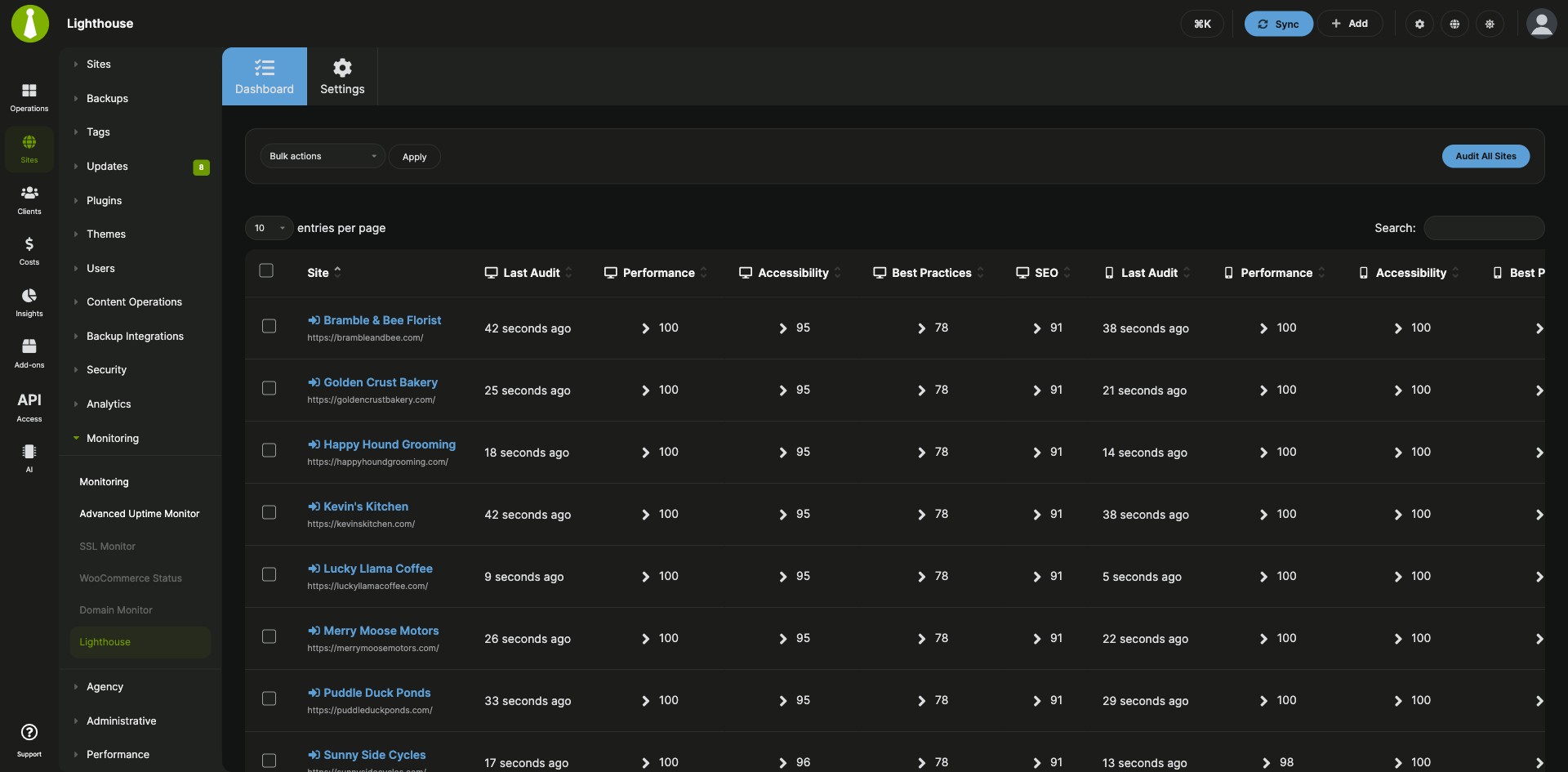

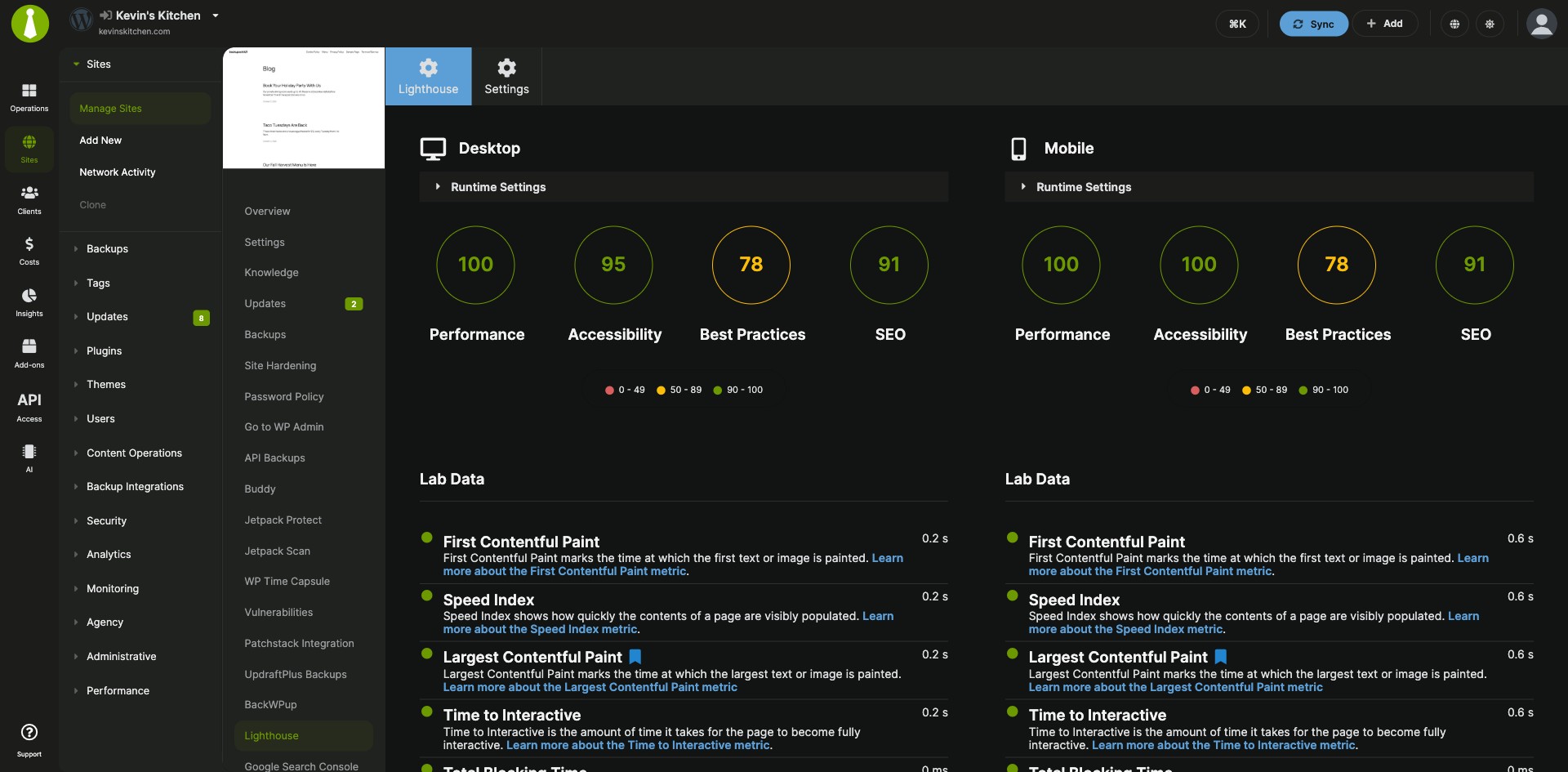
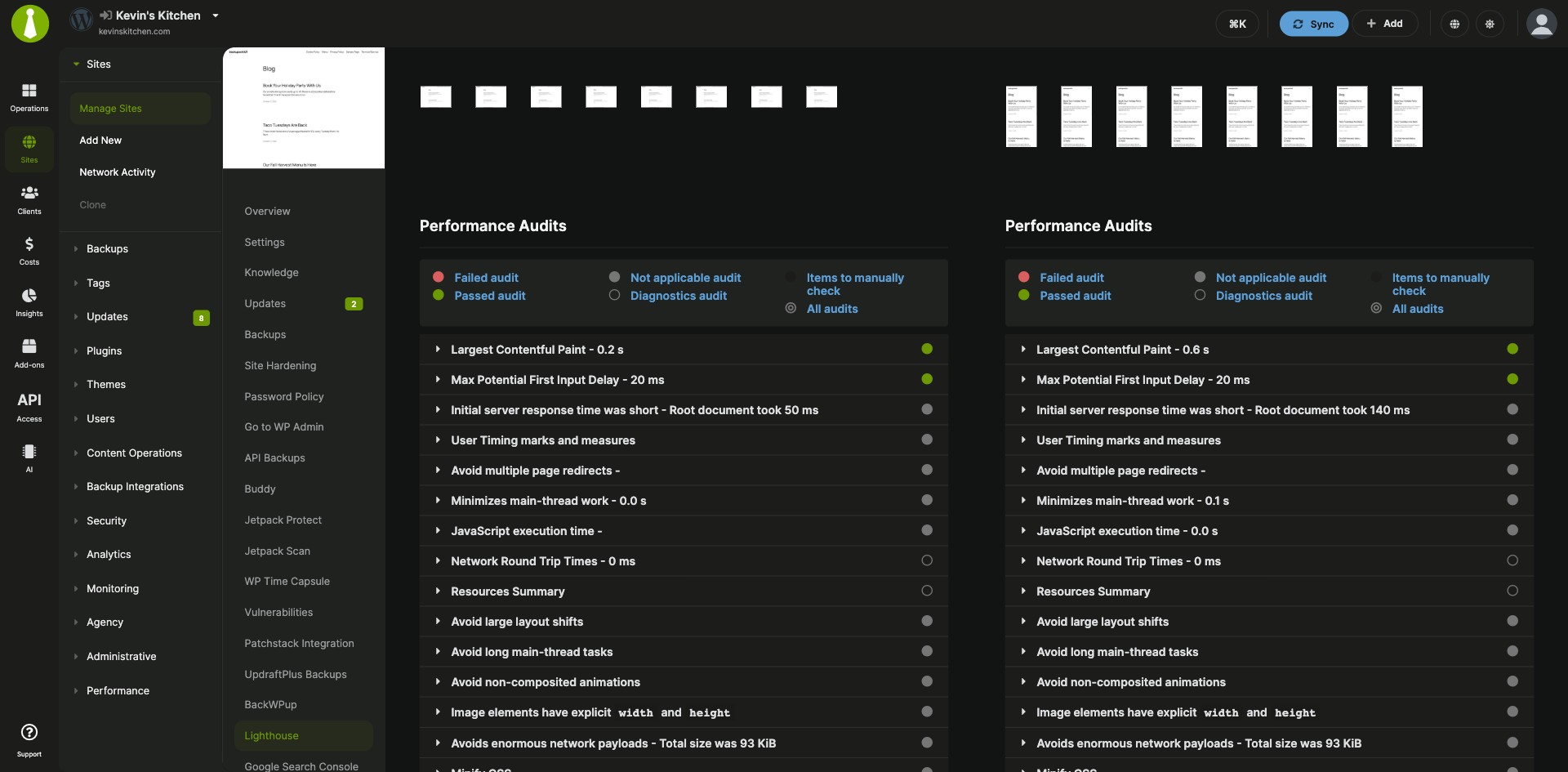
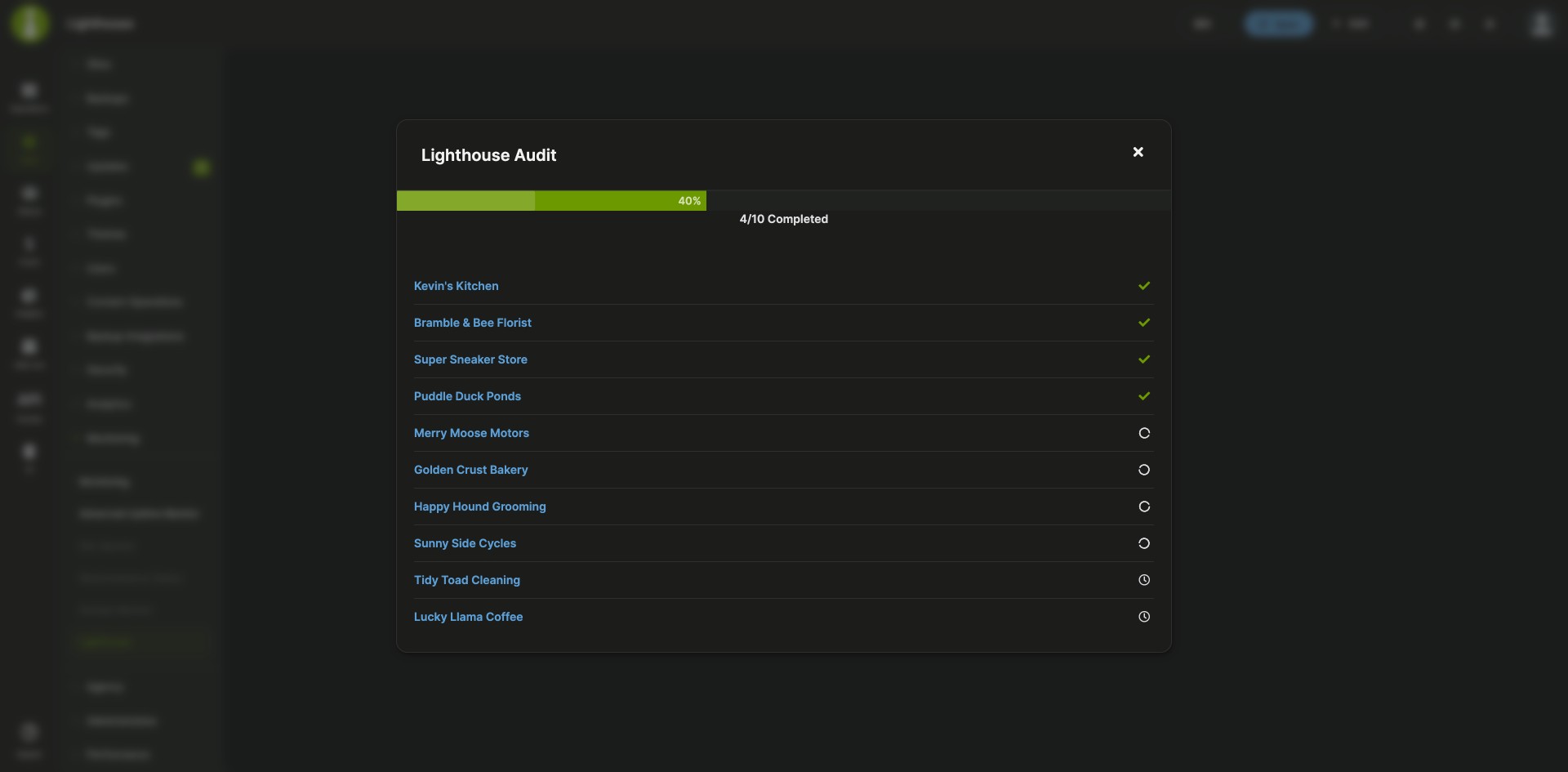

Lighthouse scores in your sites list, widgets and reports
The Lighthouse Integration is a Pro MainWP add-on that audits the performance, accessibility, best practices and SEO of your child sites through the Google PageSpeed Insights API. Lighthouse reports for each site open from your MainWP Dashboard, and the scores show up as columns in your sites list.
Testing sites one by one
Testing each client site on its own is slow, repetitive work, and the scores end up scattered across separate tabs. The Lighthouse Integration lists the latest scores for all your sites on one Dashboard page. You start audits there or let them run on a schedule, and the scores also appear in the Manage Sites table, in widgets and in client reports.
Features
The Lighthouse Integration covers running audits, reading the results and passing scores on to clients and your own tools.
| Feature | What it means for you |
|---|---|
| Audits for all, some, or one site | Click Audit All Sites on the Lighthouse Dashboard, pick sites from the Bulk Actions menu, or use the Audit Site action on a single site. Each audit scores performance, accessibility, best practices and SEO. |
| Scheduled audits | Turn on Automatically audit sites and set the Automated audit frequency, and audits run on their own. |
| Lighthouse reports | Open the Lighthouse Report action on any site to see the full report. Choose the report language and whether audits use the Desktop strategy, the Mobile strategy, or both. |
| Score columns in your sites list | Add Performance Score columns for Desktop and Mobile to the Manage Sites table from the Page Settings menu. The Manage Sites and Monitoring tables also show First Contentful Paint and whether a score went up or down since the last audit. |
| Widgets | The Operations page widget lists your best and worst performing sites. The widget on a child site’s Overview page shows its Desktop and Mobile scores and how they changed since the previous audit. |
| Score notifications | Set a Notifications threshold. When any tracked Lighthouse score is at or below that value, the add-on can send a Lighthouse notification. |
| WP-CLI and REST API | Run audits and read results from the command line with wp mainwp-lighthouse audit and wp mainwp-lighthouse results, or through the MainWP REST API. |
| Client report tokens | With Pro Reports, add Desktop and Mobile scores, the audit list and the last check time to client reports with tokens such as [lighthouse.performance.desktop], [lighthouse.seo.mobile] and [lighthouse.lastcheck.desktop]. |
Requirements
The Lighthouse Integration needs a Google PageSpeed Insights API key and runs entirely from your MainWP Dashboard.
| Item | Requirement |
|---|---|
| License | MainWP Pro |
| Google PageSpeed Insights API key | Required to run audits. You create it in your Google account and paste it into the add-on settings. |
| Child sites | Nothing to install. The add-on connects your Dashboard to the Google PageSpeed Insights API and audits each site from there. |
| Client report tokens (optional) | MainWP Pro Reports Extension |
| REST API v1 (optional) | Send audit requests to /wp-json/mainwp/v1/lighthouse/audit as POST, which the endpoint requires since version 5.3. |
Setup: add an API key and run audits
Setting up the Lighthouse Integration takes an API key from Google, the add-on itself, and a first audit, with scheduling as an optional last step.
Get a Google PageSpeed Insights API key
- Log in to your Google account and open the PageSpeed Insights API getting started page.
- Click Get a Key, select an existing project or create a new one, and click Next.
- Copy the API key and click Done.
Install the add-on and add your API key
- In your MainWP Dashboard, go to Add-ons > Manage Add-ons and click Install Add-ons.
- Select the Lighthouse add-on, click Install, then click Activate Add-ons.
- Go to Add-ons > Monitoring > Lighthouse > Settings, paste your Google PageSpeed Insights API key, and click Save Settings.
Run your first audit
- Go to Add-ons > Monitoring > Lighthouse > Dashboard.
- Click Audit All Sites and wait until the add-on completes the process.
- To audit a selection of sites, use the Bulk Actions menu. To audit one site, use the Audit Site action in its Action Menu.
Schedule automatic audits
- Go to Add-ons > Monitoring > Lighthouse > Settings.
- Enable Automatically audit sites and set the Automated audit frequency.
- Click Save Settings.
Full instructions for settings, widgets, WP-CLI and the REST API: Lighthouse Integration documentation.
How audits run
The Lighthouse Integration runs on your MainWP Dashboard and uses the Google PageSpeed Insights API, with your API key, to audit each child site. As of version 5.2, the Lighthouse Dashboard table loads and filters its data on the server, and the add-on processes up to 50 items per run to reduce memory use.
Lighthouse FAQ
Can I run Lighthouse audits from WP-CLI or the REST API?
Yes, the Lighthouse Integration runs audits and returns results through WP-CLI and the MainWP REST API. Use wp mainwp-lighthouse audit 125,126 or wp mainwp-lighthouse audit --all to run audits, and wp mainwp-lighthouse results with site IDs or --all to view them. For REST API v1, send requests to /wp-json/mainwp/v1/lighthouse/audit as POST.
Can the Lighthouse Integration notify me when a score drops?
Yes, set a Notifications threshold in the Lighthouse Integration settings. When any tracked Lighthouse score is at or below that value, the add-on can send a Lighthouse notification.
How do I give long Lighthouse audits more time to finish?
Raise Maximum execution time under Add-ons > Monitoring > Lighthouse > Settings first. If audits need more time after that, raise Maximum script run time up to the maximum your server allows. On slow web servers, a longer Throttling delay time slows reporting down and may give more accurate results.
Where do I get support?
Google handles the PageSpeed Insights API itself. See the PageSpeed Insights API documentation. MainWP support handles issues with the integration.