
Jetpack Scan Integration
Request Jetpack Scan runs on your child sites and fix the threats it finds from your MainWP Dashboard.

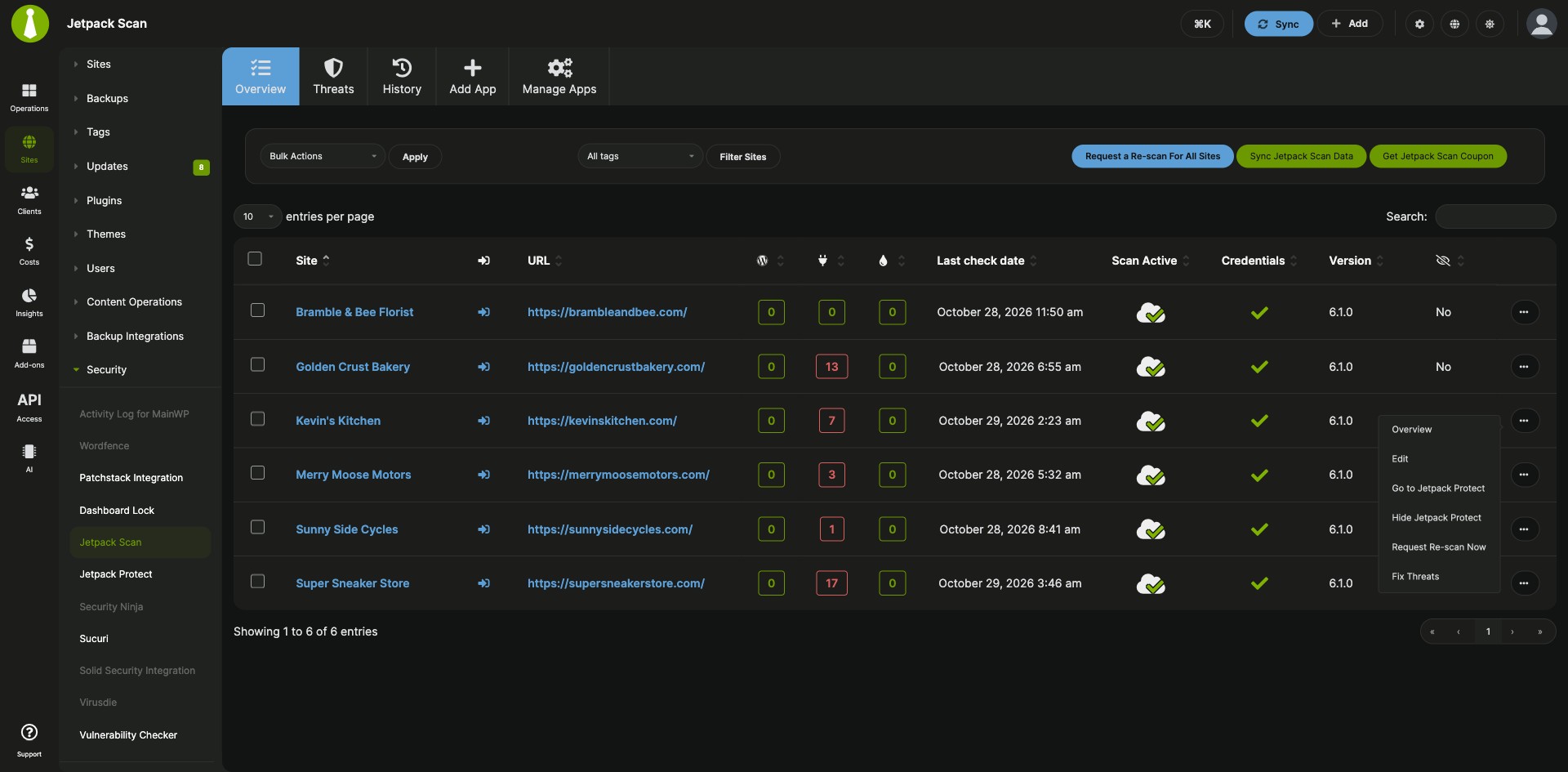

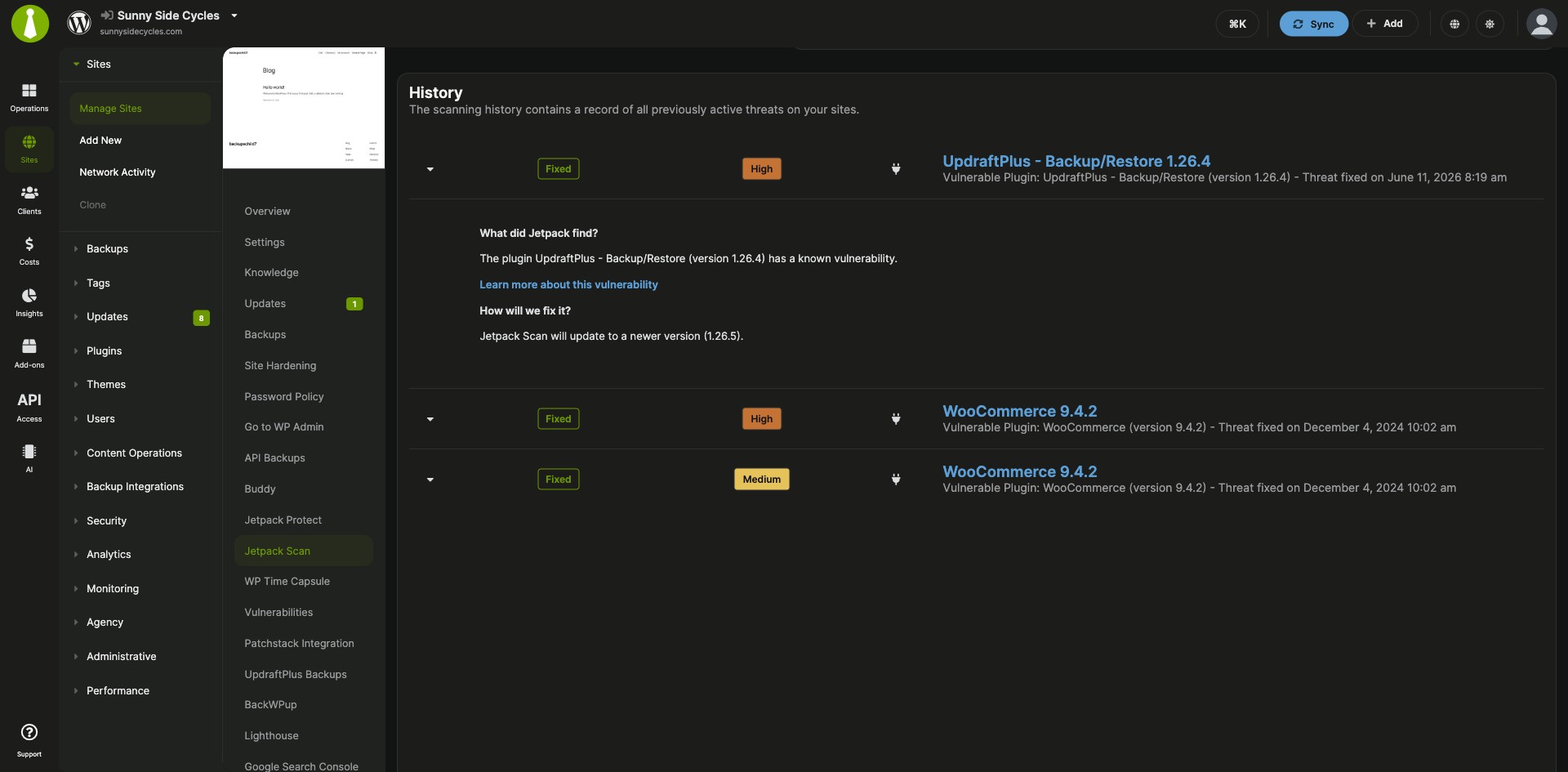
Jetpack Scan threats, fixes and history for all your sites
Jetpack Scan checks each site’s files for malware and known vulnerabilities every day. The Jetpack Scan Integration, a Pro MainWP add-on, brings those results into your MainWP Dashboard so you can review them, request new scans, and fix or ignore threats for all your child sites. Vulnerabilities in WordPress core, plugins and themes for every site appear in one table.
Check every client site’s Jetpack Scan results in one place
Without the add-on, Jetpack Scan results get checked and handled one client site at a time. The Jetpack Scan Integration puts every child site with Jetpack Scan active in one table. Request scans for one site, a selection, or all of them at once, then work through every threat from a single Threats page.
Features
The Jetpack Scan Integration covers scanning, fixing, history and reporting for every child site with Jetpack Scan active.
| Feature | What it means for you |
|---|---|
| Overview of all sites | See every child site with Jetpack Scan active in one table. The WP, Plugins and Themes columns count the vulnerabilities found on each site, and the Credentials column shows whether Jetpack can fix threats there. From the row menu or Bulk Actions you can hide or update the Jetpack plugin on child sites. |
| On-demand scans | Request a re-scan for one site from its row menu, for selected sites from Bulk Actions, or for all sites with one button. Sync Jetpack Scan Data fetches the latest results into your Dashboard. |
| Threat fixes | Click a vulnerability count on the Threats page, expand a threat, and choose Fix Threat or Ignore Threat. The Fix Threat button is active when Jetpack has a fix for the threat. |
| Threat history | Fixed and ignored threats move to the History page, which uses the same layout as the Threats page, so you can check what was handled on each site. |
| Multiple Jetpack apps | Connect more than one WordPress.com app from the Add App page. On Manage Apps you can request account access again or remove an app. |
| Jetpack Scan coupons | Request coupons for 40% off the first year of a Jetpack Scan subscription, up to the number of child sites on your Dashboard. |
| Jetpack Scan widget | A widget on the MainWP Overview page summarizes scan results for WordPress core, plugins and themes. |
| Report tokens | With Pro Reports, add [jetpack.scan.wp], [jetpack.scan.plugins] and [jetpack.scan.themes] to list detected vulnerabilities in client reports, or [jetpack.scan.plugins.count] and [jetpack.scan.themes.count] to show the counts. |
Requirements
The Jetpack Scan Integration works through your Jetpack Scan subscription and a WordPress.com app that you create.
| Item | Requirement |
|---|---|
| License | MainWP Pro |
| Jetpack malware scanning | A paid Jetpack subscription that includes malware scanning. See Jetpack pricing. |
| Child sites | The Jetpack Protect plugin with the Jetpack Scan feature activated. The full Jetpack plugin also works if you need other Jetpack modules; otherwise Jetpack Protect is preferred. |
| WordPress.com app | An application created in your WordPress.com Developer account, using the Redirect URL shown on the add-on’s Add App page |
| Fixing threats | SSH, SFTP or FTP server credentials for each child site, added in Jetpack |
| Coupons | Jetpack Scan Integration 4.0.3 or later |
| Report tokens (optional) | The Pro Reports add-on |
Setup: prepare sites, connect an app, add credentials
Setting up the Jetpack Scan Integration has four parts, from the child sites to the server credentials Jetpack uses for fixes.
Prepare your child sites
- Install the Jetpack Protect plugin on your child sites.
- Activate the Jetpack Scan feature on each site. Jetpack’s help article covers the steps.
Install the add-on
- In your MainWP Dashboard, go to MainWP > Add-ons and click Install Add-ons.
- Select the Jetpack Scan Integration and click Install.
- When the installation finishes, click Activate Add-ons.
Connect the add-on to Jetpack
- Open the Add-ons > Jetpack Scan > Add App page and note the Redirect URL value.
- In your WordPress.com Developer account, fill in the form to create an application, using that Redirect URL.
- To connect more apps, repeat the process on the Add App page. All apps appear on the Manage Apps page.
Let Jetpack fix threats
- Add SSH, SFTP or FTP credentials for each child site in Jetpack, following Jetpack’s credentials guide.
- Click Sync Jetpack Scan Data to fetch the latest data. The Credentials column on the Overview page shows a green checkmark for sites with valid credentials.
Full instructions for scans, threats and coupons: Jetpack Scan Integration documentation.
Where scan data and fixes come from
The Jetpack Scan Integration runs on your MainWP Dashboard and gets scan data from Jetpack through the Jetpack Scan API, using the WordPress.com apps you connect. Scans and fixes run through Jetpack. For free vulnerability scanning with the Jetpack Protect plugin, see the Jetpack Protect Integration.
Jetpack Scan FAQ
What else do I need to use this add-on?
You need MainWP Pro and a paid Jetpack subscription that includes malware scanning. See Jetpack pricing.
What does Jetpack need to fix threats on a child site?
Jetpack needs SSH, SFTP or FTP credentials for a child site before the Jetpack Scan Integration can fix threats there. A green checkmark in the Credentials column on the Overview page means the credentials are valid, and a red X means they still need adding or correcting. Add them in Jetpack, then click Sync Jetpack Scan Data.
How long does it take to fix a threat?
Fixes run through Jetpack in the background, so you can start one, move on to other work, and check back in a few minutes. Depending on the Jetpack products on the site, Jetpack may take a backup first, so you have a restore point before anything changes.
Where do I get support?
The Jetpack team handles issues with Jetpack Scan and the Jetpack Protect plugin. See jetpack.com. MainWP support handles issues with the integration.